
Key Takeaways
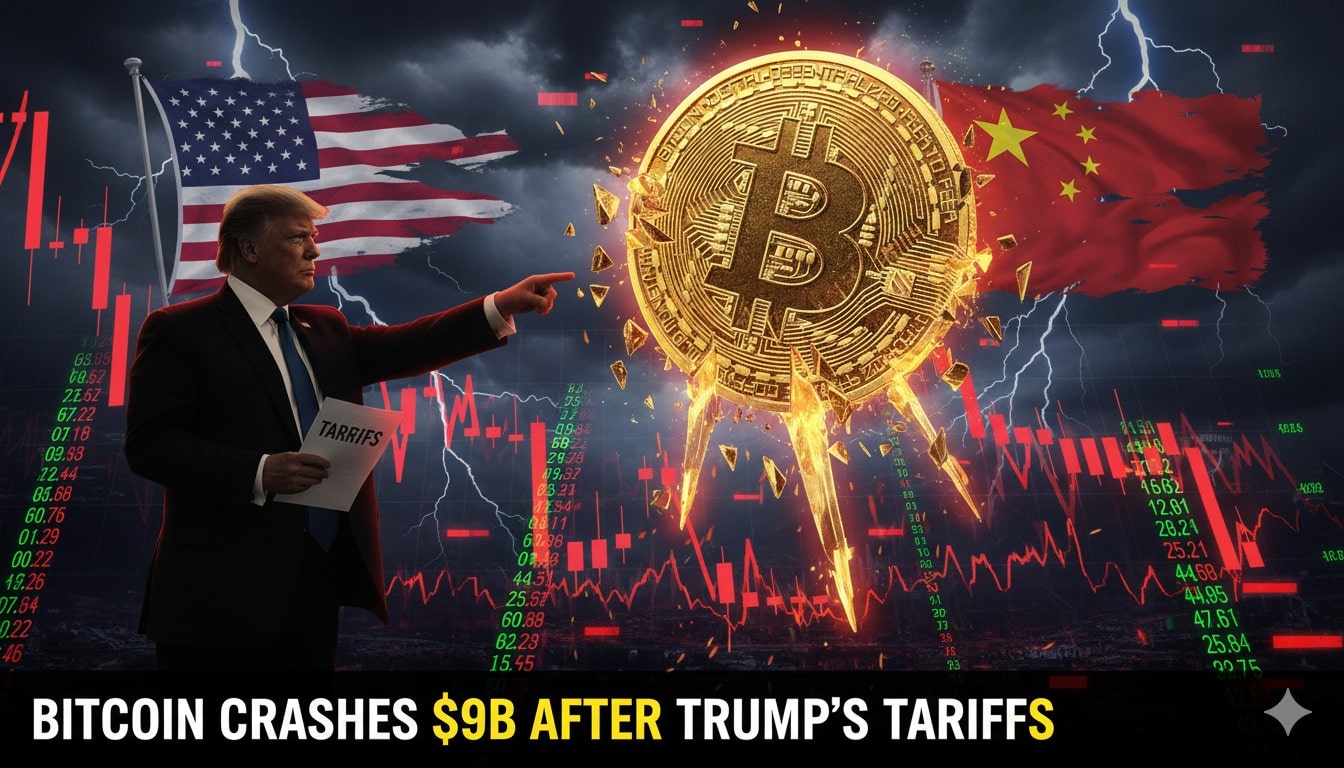
- Bitcoin crashed to $102K after Trump’s 100% tariffs on China rattled global markets
- Over $9 billion in crypto positions were liquidated within 24 hours
- Ethereum and Solana also dipped sharply, dragging the entire crypto market down
- Tariff tensions raised serious concerns about chip supplies vital for crypto mining
- Here’s what it all means – and what you can do to protect yourself right now
What Happened: Bitcoin’s Sudden $102K Drop Explained
Imagine waking up and checking your phone, only to see Bitcoin down tens of thousands of dollars in just a few hours. Scary, right? That’s exactly what happened when Bitcoin crashes to $102K after Trump’s 100% tariffs on China sent shockwaves through financial markets worldwide.
On what seemed like an ordinary trading day, President Donald Trump announced sweeping 100% tariffs on Chinese imports, escalating the US-China trade war to levels we haven’t seen in years. Within hours, Bitcoin plunged from around $108,000 to hit $102,000 — a brutal drop that wiped out billions in value and left traders scrambling.
But here’s the thing: this wasn’t just about one cryptocurrency. The entire crypto market went into panic mode. Ethereum dropped nearly 8%, Solana fell by double digits, and smaller altcoins got hammered even worse. It was what traders call an “altcoin bloodbath,” and it happened fast.
So what’s really going on? Let’s break it down in plain English.
Why Trump’s 100% Tariffs on China Shocked the Crypto Market
You might be wondering: what do trade tariffs have to do with Bitcoin? Great question. At first glance, crypto seems disconnected from traditional politics. After all, Bitcoin was created to be independent of government control, right?
Here’s the reality: crypto doesn’t exist in a vacuum. When major economic shocks hit global markets, investors get nervous — really nervous. And when people get scared, they often pull money out of riskier assets like cryptocurrencies and move into safer options like cash, gold, or government bonds.
The trump 100% tariffs china bitcoin impact was immediate because tariffs on this scale create massive uncertainty. Companies don’t know what their costs will be next month. Supply chains get disrupted. Manufacturing gets more expensive. And investors hate uncertainty more than almost anything else.
Think of it like this: when dark storm clouds roll in, most people head indoors. In financial markets, tariff announcements are those storm clouds, and Bitcoin is often treated as an “outdoor” asset — exciting when the weather’s good, but risky when conditions turn bad.
Plus, there’s a practical angle. China is a massive player in the semiconductor industry and rare earth materials — both critical for making the chips used in crypto mining hardware. When Trump slapped 100% tariffs on Chinese goods, it raised immediate questions about whether mining equipment would become more expensive or harder to get. More on that later.
$9B in Liquidations — What Really Happened Behind the Scenes
Here’s where things get really interesting. According to data from CoinGlass, a respected crypto market analytics platform, over $9 billion in leveraged crypto positions were liquidated within 24 hours of Trump’s tariff announcement. That’s billion with a B.
But what does “liquidation” actually mean? Let me explain it simply.
Many crypto traders don’t just buy Bitcoin and hold it. They use something called leverage — basically borrowing money to make bigger bets. If you have $1,000 and use 10x leverage, you’re controlling $10,000 worth of Bitcoin. When prices go up, your profits multiply. Sounds great, right?
The problem comes when prices drop. If Bitcoin falls even a little bit, your leveraged position can get automatically closed out (liquidated) by the exchange to prevent you from losing more than you have. It’s like the casino taking your chips when you run out of money.
When Bitcoin price drop after china tariffs 2025 started happening, it triggered a domino effect. Traders with leveraged long positions (betting prices would go up) got liquidated first. This forced selling pushed prices down even more, which triggered more liquidations, which pushed prices down further. It’s a vicious cycle that market veterans call a “cascade.”
Binance, the world’s largest crypto exchange, saw particularly heavy action in its BTC/USDT futures market. Binance bitcoin futures plunge to $102000 happened within hours, and thousands of traders watched their positions get wiped out in minutes.
To put $9 billion in perspective: that’s more than the entire market cap of some mid-sized cryptocurrencies. It’s real money, gone in less than a day.
How the US–China Trade War Impacts Bitcoin and Altcoins
The bitcoin market reaction to us-china trade war isn’t actually new. We’ve seen similar patterns before during previous trade disputes, but this time felt different because of the scale — 100% tariffs are historically aggressive.
Here’s what happens behind the scenes: when the United States and China are in a serious trade conflict, it creates ripples across the entire global economy. Manufacturing slows down. Import costs rise. Companies hold off on big investments. Consumer confidence drops.
Bitcoin often gets caught in the crossfire because it’s still seen by many institutional investors as a “risk-on” asset — something you buy when you’re feeling optimistic and confident, not when you’re worried about a recession or trade war.
The altcoins suffered even more dramatically. Ethereum, which had been trading around $2,800, dropped to below $2,600. Solana fell from approximately $170 to around $155. Smaller cryptocurrencies saw drops of 15-20% or more.
Why do altcoins get hit harder than Bitcoin? Think of Bitcoin as the blue-chip stock of crypto — relatively more stable and established. Altcoins are like small-cap stocks — higher risk, higher reward, but also first to sell off when panic sets in.
The bitcoin and altcoin liquidation after tariff announcement created what traders call “max pain” — when the maximum number of leveraged positions get destroyed at once. It’s brutal to watch, but it’s a reminder of how connected crypto markets are to global events.
Did Binance Futures Cause the Bitcoin Crash?
This is a question that pops up every time we see massive volatility: did exchanges like Binance actually cause the crash, or were they just the venue where it played out?
Short answer: Binance didn’t cause the crash. The tariff announcement was the trigger. But Binance’s massive futures market definitely amplified the volatility.
Here’s how it works: Binance offers some of the highest leverage in the industry — up to 125x on certain pairs. That means with just $100, a trader could control $12,500 worth of Bitcoin. When you have millions of traders using high leverage, price movements get exaggerated.
When Bitcoin started dropping on the tariff news, Binance’s automated liquidation system kicked in. Positions got closed, which meant more selling pressure, which pushed prices down further, which triggered more liquidations. It’s like a chain reaction that feeds on itself.
Other major exchanges like Coinbase, Kraken, and Bybit saw similar patterns, but Binance’s sheer volume (they handle about 40-50% of global crypto trading) meant their market moved faster and harder.
To be clear: this isn’t Binance’s fault. They’re just providing a market. But it’s a good reminder that leverage is a double-edged sword. It can multiply your gains, but it can absolutely wreck your portfolio in volatile conditions.
The Hidden Link Between Tariffs and Crypto Mining Hardware
Here’s something most people miss when they think about trade tariffs and crypto: the physical infrastructure that keeps Bitcoin running depends heavily on specialized computer chips.
Bitcoin mining requires powerful machines called ASICs (Application-Specific Integrated Circuits). These aren’t your regular computers — they’re custom-built chips designed to do one thing incredibly well: solve the complex math problems that secure the Bitcoin network.
Guess where many of these chips and their components come from? You got it — China and Taiwan.
The rare earth export controls effect on crypto mining is very real. Rare earth elements are special minerals used in semiconductor manufacturing. China controls a huge portion of global rare earth production. When Trump imposed 100% tariffs on Chinese goods and China responded with export restrictions on rare earth materials, it raised immediate concerns:
- Will mining hardware become more expensive?
- Will semiconductor shortages affect Bitcoin’s network security?
- Could mining companies face disrupted supply chains?
These aren’t just theoretical worries. During the semiconductor shortage of 2021-2022, mining hardware prices skyrocketed. Some mining rigs that normally sold for $3,000 were going for $10,000 or more.
If the semiconductor shortage and mining hardware supply chain gets disrupted again, it could push mining costs higher. When mining becomes more expensive, smaller miners might shut down operations, which affects Bitcoin’s hash rate (the total computing power securing the network).
The good news? Bitcoin’s network is resilient and has weathered similar storms before. But it’s definitely something miners and long-term investors are watching carefully.
What This Means for Bitcoin Traders and Long-Term Investors
Okay, so we’ve covered what happened and why. But here’s what you really want to know: what does this mean for your portfolio?
For short-term traders, the crypto market liquidation after trump tariff created both danger and opportunity. If you were over-leveraged and betting on prices going up, you probably got liquidated. That hurts, and there’s no sugar-coating it.
But for traders who kept cash on the sidelines or used proper risk management, the drop to $102K presented a potential buying opportunity. Bitcoin has historically bounced back from macro-driven selloffs, though of course past performance doesn’t guarantee future results.
For long-term investors (the “HODLers” in crypto speak), this is likely just another chapter in Bitcoin’s volatile story. Remember, Bitcoin has survived:
- The 2018 crash from $20K to $3K
- The March 2020 COVID panic that briefly pushed it below $4K
- China’s mining bans in 2021
- The FTX collapse in 2022
- Multiple 50%+ corrections
Each time, Bitcoin eventually recovered and went on to make new highs. The question is always about timing and patience.
One important consideration: how geopolitical tariffs move bitcoin price short term versus long term. Short-term moves are often driven by fear and leverage liquidations — they’re messy and unpredictable. Long-term moves depend more on adoption, institutional investment, regulatory clarity, and Bitcoin’s fundamental value proposition as a decentralized asset.
If you believe in Bitcoin’s long-term potential, a drop to $102K might look like a discount in six months. If you’re trading short-term, these volatile swings are exactly why risk management matters so much.
How to Protect Your Crypto Portfolio From Market Shocks
Alright, here’s the practical stuff — the actions you can take right now to protect yourself from getting wrecked during the next surprise announcement or market crash.
Use Stop-Loss Orders
A stop-loss is an automatic order that sells your position if the price drops to a certain level. Think of it as a safety net. If you bought Bitcoin at $105K, you might set a stop-loss at $100K. If prices crash to $102K and keep falling, your position automatically sells at $100K, limiting your losses. Yes, you might miss out if prices bounce back quickly, but you also won’t ride the position all the way down to $80K.
Reduce or Avoid High Leverage
This is probably the single most important lesson from the $9 billion liquidation event. Leverage amplifies both gains and losses. Using 10x, 20x, or higher leverage might seem exciting, but it means you can get wiped out by a 5-10% move. If you must use leverage, keep it low (2x-3x maximum) and always have a clear exit plan.
Diversify Your Holdings
Don’t put everything into Bitcoin or even just crypto. Spread your investments across different asset classes: some crypto, some stocks, some bonds, maybe some gold or real estate. When one market crashes, others might hold steady or even go up. It’s the basic principle of not putting all your eggs in one basket.
Track Major Macro Events
Crypto doesn’t trade in isolation anymore. Watch for major announcements like Federal Reserve decisions, inflation reports, and geopolitical news like trade wars. Set up alerts on your phone for breaking news. Being aware of when volatility might hit gives you a chance to prepare.
Keep Cash Available
When markets panic and prices crash, having cash on the sidelines means you can buy at discounted prices. Some of the best crypto investors always keep 20-30% of their portfolio in stablecoins or regular cash, ready to deploy when opportunities arise.
Understand Your Risk Tolerance
Be honest with yourself: can you handle watching your portfolio drop 20%, 30%, or even 50%? If the answer is no, you’re probably over-invested in volatile assets. There’s no shame in reducing your crypto allocation to a level where you can sleep at night.
These aren’t guarantees — nothing in investing is. But how to protect crypto portfolio from trade war shocks comes down to these fundamental principles: manage risk, stay informed, and never bet more than you can afford to lose.
Final Thoughts: Will Bitcoin Bounce Back After the Tariff Chaos?
Look, I’m not going to lie to you — nobody knows for sure where Bitcoin goes from here. Anyone who tells you they know exactly what will happen next is either lying or fooling themselves.
But here’s what we do know: Bitcoin has survived worse. It’s been declared “dead” hundreds of times by media outlets and skeptics. It’s weathered government crackdowns, exchange collapses, and multiple 80%+ crashes. Each time, it’s come back.
The fundamentals that make Bitcoin interesting haven’t changed. It’s still decentralized. It still has a fixed supply of 21 million coins. It’s still operating 24/7 across the globe. And it’s still attracting interest from major institutions, from spot Bitcoin ETFs managing billions to companies adding it to their balance sheets.
Will the US-China trade war drag on and create more volatility? Probably. Will there be more scary headlines and sudden price drops? Almost certainly. Welcome to crypto — it’s not for the faint of heart.
But if you’re in this for the long haul, if you’ve done your research, and if you’re managing your risk properly, then days like this are just part of the journey. They’re stressful, yes. They test your conviction. But they also separate the speculators from the true believers.
The crash to $102K might turn out to be a temporary dip that everyone forgets about in three months. Or it might be the start of a longer correction. Either way, the most important thing you can do is stay calm, stick to your investment strategy, and keep learning.
Bitcoin has been counted out before. Every single time, it’s proven the doubters wrong. Will this time be different? We’ll find out together.
Stay safe out there, manage your risk, and remember — in crypto, survival is the first step to success.